Home › Guides › Lawn & Farm Equipment › Hardfacing guide
Hardfacing Guide: Rebuilding Bucket Edges, Teeth and Tillage Tools
From CanItBeWelded.com, run by Rick, a working welder at RickTheWelder. Published November 29, 2026. How we write and check guides.
Quick answer
- Hardfacing is a hard weld layer applied to surfaces that wear: bucket lips and corners, teeth adapters, cutting edges, plow and ripper points, and conveyor and mixer parts.
- Match the alloy to the wear. Abrasion from sand and soil favors carbide-rich types; heavy impact favors tougher, impact-resistant types.
- Rebuild first. If the part is worn thin, build it back with a tough buildup filler before applying hardfacing on top.
- Limit layers. Many hardfacing alloys are brittle and are rated for only a few layers. Check the maker's limit.
- Replace bolt-on wear parts such as edges and teeth when they are cheaper than rebuilding.
What hardfacing is for
Steel that digs, scrapes or moves material wears away. Hardfacing deposits a weld layer much harder than the base steel so the part wears more slowly. It is used both on new parts to make them last and on worn parts to restore and protect them. It is not a way to join parts, and hardfacing alloys are generally not used for structural welds because they are brittle.
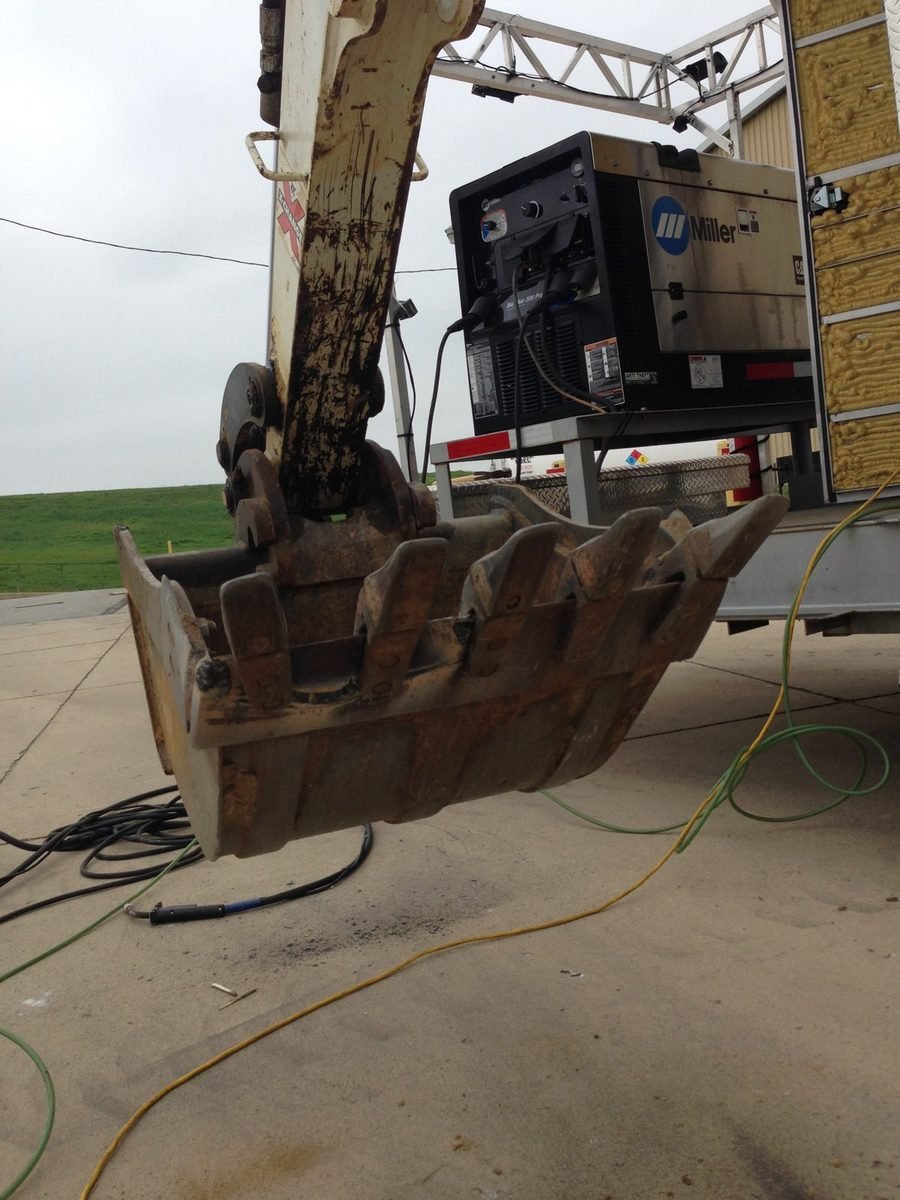
Types of wear and types of hardfacing
- Abrasion: sand, soil, gravel and grain scouring a surface. Chromium carbide and tungsten carbide hardfacing resist abrasion well. Chromium carbide deposits commonly show fine cross-check cracks as they cool; makers describe this as normal for that type.
- Impact: rocks and pounding. Tougher, more impact-resistant alloys and austenitic manganese types are used where shock dominates.
- Combination: most farm and digging work mixes both, so many general-purpose hardfacing rods aim for a balance.
Hardfacing rod and wire makers publish selection charts by application. Use them to pick a product rather than guessing by hardness number alone.
Step by step
- Clean and inspect. Remove dirt, grease and old cracked hardfacing. Check for cracks in the base metal and repair those first with proper filler. See excavator bucket.
- Identify the base metal. Most buckets and edges are carbon or high-strength steel; some wear parts are manganese steel, which is nonmagnetic and must be welded cool. See cast steel and manganese steel.
- Preheat if needed. Thick or high-carbon parts benefit from preheat. See when to preheat.
- Rebuild worn areas with a buildup filler suited to the base metal, so the hardfacing is not piled too thick.
- Apply hardfacing in the pattern that suits the material (below), within the maker's layer limit.
- Cool slowly and do not quench.
Bead patterns
- Stringer beads across the flow of fine material: sand and soil pack between the beads and protect the base metal.
- Stringer beads with the flow when handling rocks: large rocks ride on the beads instead of gouging between them.
- Waffle or crosshatch: a mix of both, common on bucket bottoms and wear areas.
- Dot pattern: spaced dots limit heat on thinner parts and still protect the surface.
Pattern guidance is widely published by hardfacing makers. Follow theirs for the product you use.
Hardface, rebuild or replace?
Bolt-on cutting edges, teeth and points are designed to be replaced. If new ones are available and the base is sound, swapping them is often faster. Weld-on edges, bucket lips, side cutters and heel plates are good rebuild and hardfacing candidates. Buckets with cracked hinge plates or worn pin bores need structural repair first; hardfacing will not fix those. See loader bucket and farm equipment.
Choosing a hardfacing rod or wire
Hardfacing consumables are usually grouped by what they resist. Read the maker's data sheet for any product you buy, because names and alloys vary.
- Build-up alloys: tough, moderately hard metal for restoring worn parts to size before a hard top layer. They resist cracking under impact.
- Impact resistant alloys: often manganese types, used where parts take heavy blows, such as crusher and hammer parts.
- Abrasion resistant alloys: often chromium carbide types, used where sand, soil and gravel grind metal away, such as bucket edges, tillage points and auger edges. These are very hard and commonly develop small cross cracks as they cool.
Many jobs use two layers: build-up first to restore thickness, then one or two passes of a hard alloy on top. Most makers limit how many layers of the hardest alloys you should apply, because thick hard deposits can spall off.
Manganese steel and other special base metals
Some heavy wear parts are made of austenitic manganese steel, which hardens as it is pounded. It needs different handling from ordinary steel: keep heat input low and the part cool, and use filler meant for manganese steel. Other wear parts are hardened alloy steel or cast iron. If you are not sure what a part is, check with the maker or test it before welding. A magnet test helps here, since manganese steel is generally nonmagnetic while ordinary carbon steel is magnetic. See how to identify metal and hardened steel.
Mistakes that shorten hardfacing life
- Welding over rust, dirt or old cracked overlay: grind back to sound metal first.
- Too many layers of a hard alloy: deposits that are too thick tend to spall.
- Skipping build-up on badly worn parts: piling hard alloy on to restore size wastes rod and invites cracking.
- Too much heat on thin parts: it can warp the part or soften heat treated base metal.
- Wrong bead direction: beads laid in the wrong direction can channel abrasive material and wear grooves faster. Match the pattern to the material, as described above.
Need starting amps for buildup rod? Use the Welding Settings Calculator.
🧰 Tools & parts for this job
The links in the strip at the top of this page are Amazon searches for the gear this job uses. They are paid links (Amazon Associate), not endorsements of a specific product. Links never change a verdict.
⚠️ Safety
- Hardfacing fume can contain chromium and manganese. Ventilate and use a respirator rated for welding fume.
- Block buckets and implements securely before working under or around them.
- Hardfacing deposits are brittle and can chip. Wear eye protection when chipping slag and grinding.
- Do not hardface parts that need to flex or carry structural loads.
Common questions
Can you hardface over old hardfacing?
Sometimes, if the old layer is sound and you stay within the maker's layer limit. Cracked or spalling hardfacing should be ground off first.
Do hardfacing cracks mean the weld failed?
Not always. Chromium carbide hardfacing commonly forms fine cross-check cracks as it cools, which makers describe as normal. Cracks that run into the base metal or cause spalling are a problem.
Can I hardface with a 120V welder?
Hardfacing flux-core wires and small rods exist for light machines, but heavy buckets and edges are better done with a larger machine.
Should I hardface a new bucket?
Many owners do on edges, corners and wear strips to extend life, especially in sandy or rocky ground.
Can you hardface manganese steel?
Yes, with filler made for manganese steel and low heat input. Keep the part cool between passes.
How many layers of hardfacing can I put on?
It depends on the alloy. Many abrasion resistant alloys are limited to one or two layers, so check the maker's data sheet and use a build-up alloy underneath if the part needs restoring.